

When an incident occurs, the ability to deliver a clear message to the right area can directly support response coordination. Emergency broadcasting can be used for warnings, evacuation instructions, production safety messages and urgent public communication.
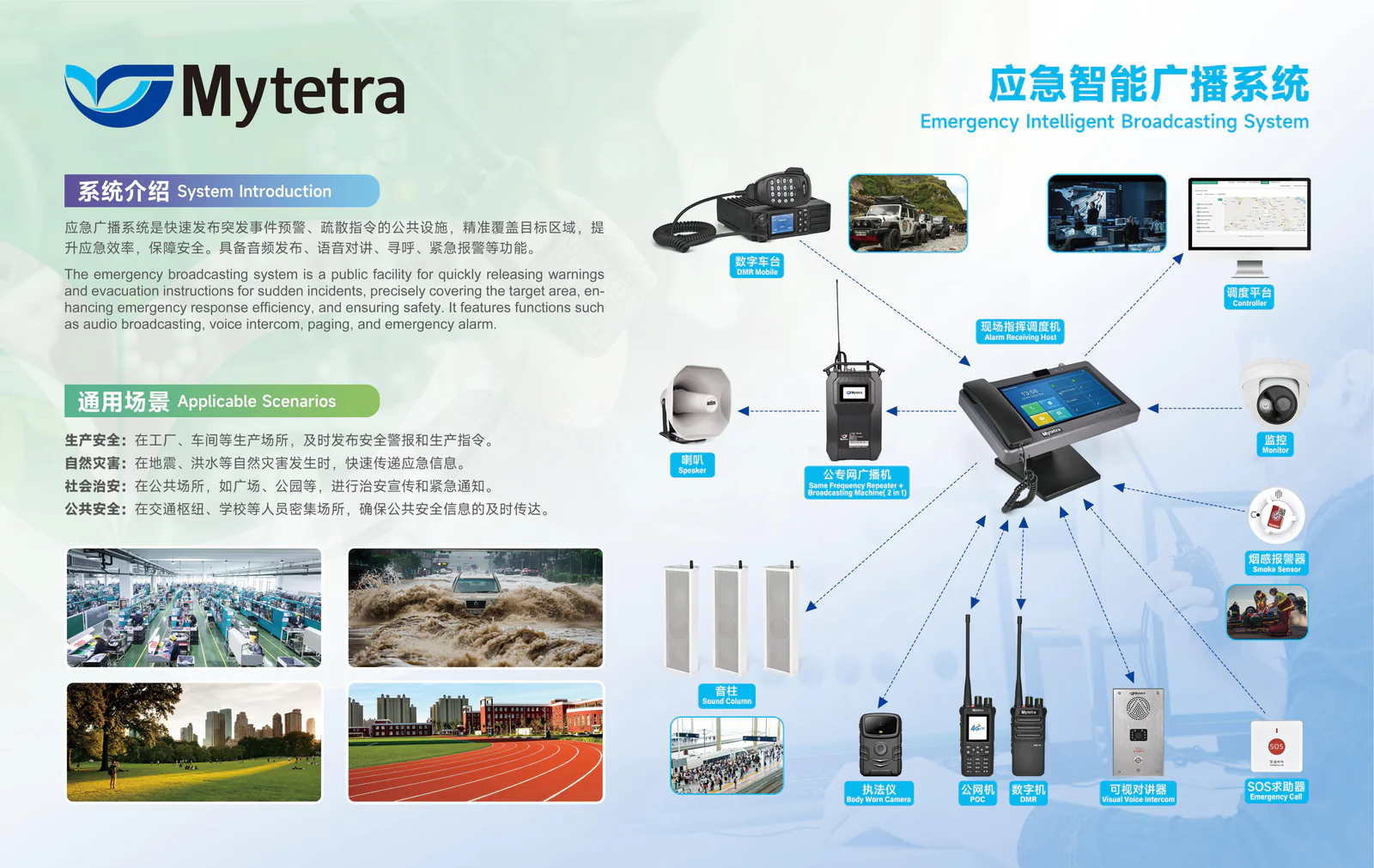
MYT’s emergency intelligent broadcasting system materials describe a public facility for quickly releasing warnings and evacuation instructions for sudden incidents. The system is designed to support precise area coverage and functions such as audio broadcasting, voice intercom, paging and emergency alarm.
Applicable Scenarios
The poster identifies several application scenarios:
- Production safety: releasing safety warnings and production instructions in factories and workshops
- Natural disasters: delivering emergency information during earthquakes, floods and similar events
- Public safety: providing governance announcements and urgent notifications in public places
- Crowded facilities: delivering timely information in transportation hubs, schools and similar locations
Connected Devices and Control
The system diagram includes a control platform, an alarm receiving host, repeaters, sound columns, digital radios, public-network radios, visual voice intercom devices, smoke sensors, monitoring devices, body-worn cameras and SOS emergency call devices.
This type of architecture can help connect the command center with field equipment and communication terminals. The final device combination should follow the site’s operational procedures, alarm interfaces and coverage requirements.
A Structured Broadcast Workflow
A typical workflow may include:
- An alarm or emergency event is detected.
- The command or receiving platform identifies the target area.
- Operators issue a voice message, paging instruction or alarm broadcast.
- Field speakers and terminals deliver the message.
- Monitoring and communication devices support situational awareness and follow-up.
Conclusion
Emergency intelligent broadcasting can provide a structured way to distribute safety messages across factories, public facilities, schools, transportation hubs and other operating environments. The value of the system depends on clear zoning, reliable equipment integration and well-practiced emergency procedures.
Contact MYT to plan an emergency broadcasting system for your facility.