

Emergency communication systems must continue to support teams when infrastructure is damaged, power is interrupted or the operating area changes quickly. Voice communication, data transmission, video awareness and dispatch coordination may all be needed in the same response process.
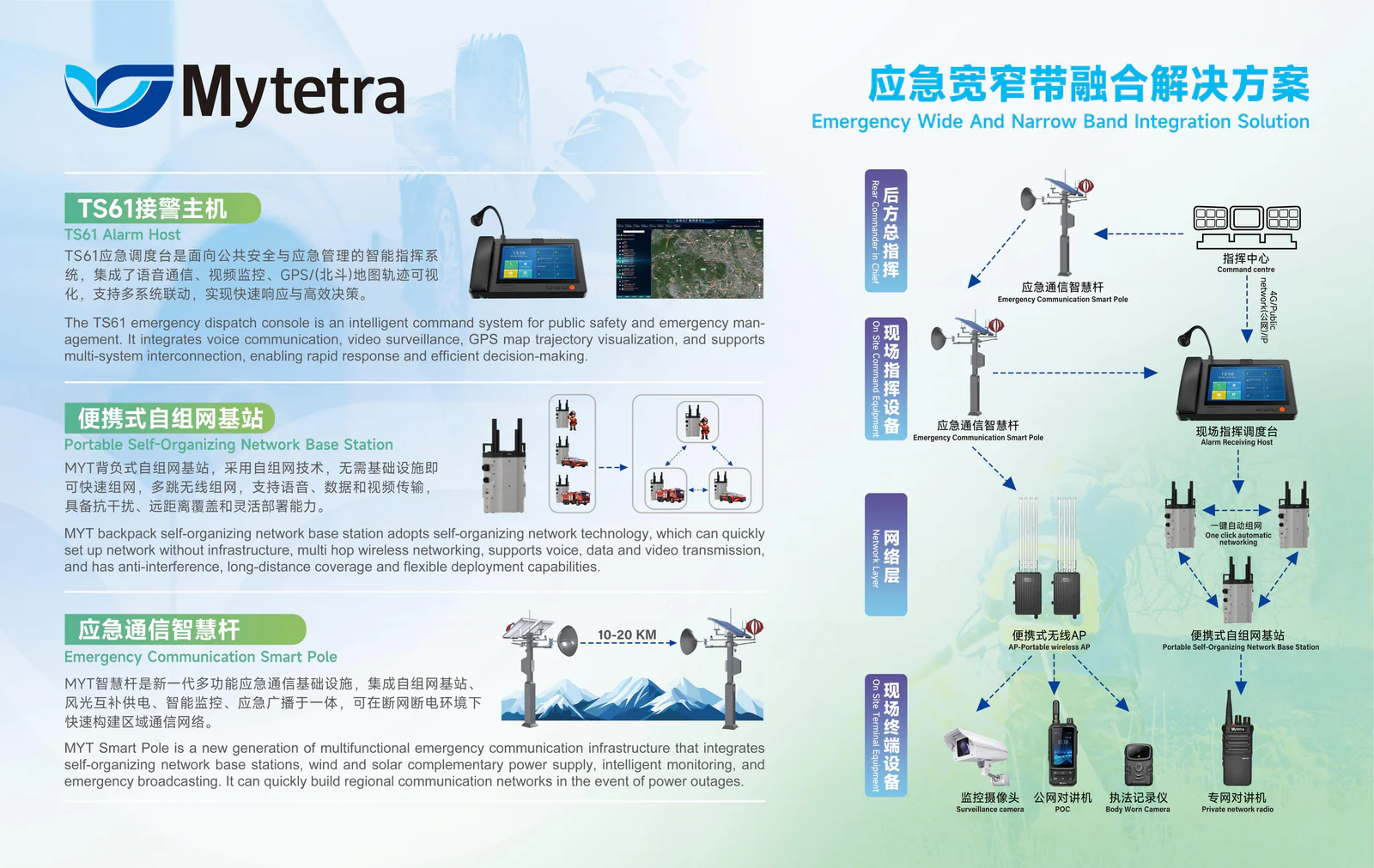
The MYT emergency wide-and-narrowband integration solution is designed around the combination of broadband and narrowband communication. The supplied poster shows an architecture connecting a command center, emergency communication smart poles, an alarm receiving host, portable wireless access points, self-organizing network base stations and field equipment.
TS61 Alarm Host
The TS61 alarm host is described as an intelligent command system for public safety and emergency management. Its listed functions include voice communication, video surveillance, GPS trajectory visualization and multi-system interconnection to support rapid response and decision-making.
Portable Self-Organizing Network Base Station
The portable self-organizing network base station is presented as a system that can quickly build a network without fixed infrastructure. The material highlights multi-hop wireless networking, voice, data and video transmission, anti-interference capability, long-distance coverage and flexible deployment.
Emergency Communication Smart Pole
The emergency communication smart pole combines a self-organizing network base station, wind and solar complementary power supply, intelligent monitoring and emergency broadcasting. The poster describes a 10–20 km communication distance between smart poles. Actual coverage depends on terrain, radio conditions, equipment configuration and project design.
A Layered Emergency Architecture
A practical emergency communication architecture may include:
- Command-center supervision
- On-site alarm receiving and dispatch
- Portable access points
- Self-organizing network nodes
- Private and public-network radios
- Body-worn cameras and surveillance cameras
- Emergency broadcast speakers and alarm devices
Conclusion
Wideband and narrowband systems can provide complementary capabilities during emergency operations. A layered architecture helps teams combine voice, data, video, alarm and dispatch functions according to the response scenario.
Talk to MYT about resilient communication for emergency response and temporary field operations.